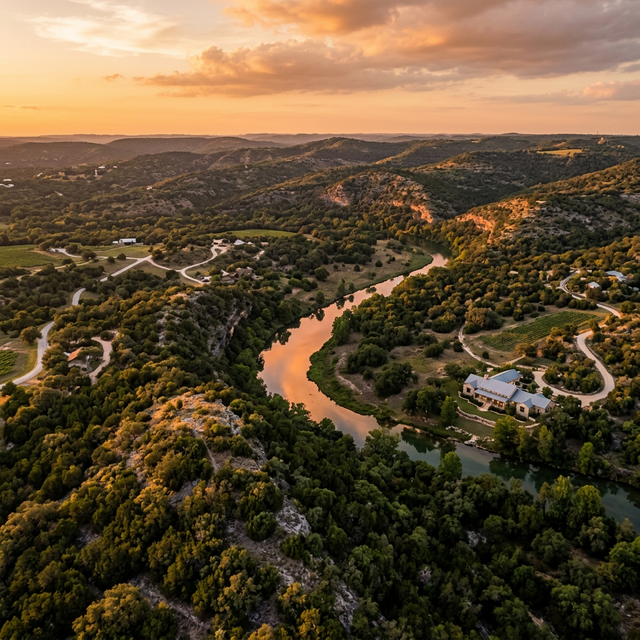
There is a design movement reshaping the Texas Hill Country that does not have a name yet, but you know it when you stand inside it. It is the feeling of a soaring cathedral ceiling framed by dark steel and warm reclaimed timber. A fireplace wall of locally quarried limestone that runs floor to vault. Glass that disappears into the landscape on all sides, so that the live oaks and the cedar hills become the room itself. This is the material language of modern Texas ranch architecture — and in 2025 and 2026, it has fully matured into a distinct regional idiom.
It is not minimalism in the European tradition, nor is it the baroque excess that defined Texas luxury building in the 1990s and early 2000s. It is something more considered: a synthesis of permanent materials drawn from the land it sits on, precision-engineered structural systems, and a rigorous commitment to indoor-outdoor integration. The result is homes that feel both ancient and architectural, both deeply Texan and internationally sophisticated.
Limestone: The Foundation Material
Limestone remains the defining material of Texas Hill Country construction in 2025 — not as a historical choice, but as an active and evolving architectural language. The Edwards Plateau sits atop one of the richest limestone deposits in North America. Local quarries in Marble Falls, Georgetown, and throughout Gillespie and Kerr Counties produce a range of limestone varieties — cream-colored Leuders, warm-toned Austin White, and the distinctively patterned Texas Shellstone — and the best custom builders are specifying these materials with the same intentionality that European architects bring to Italian travertine.
In the most significant contemporary Hill Country homes, limestone is used three-dimensionally: as exterior cladding, as interior floor material, as fireplace surround, as structural retaining walls that dissolve into landscape. Locally sourced limestone carries additional value beyond aesthetics — it speaks to permanence, authenticity, and a genuine connection to place that imported cladding materials can never replicate.
Steel: The Precision Element
If limestone provides the warmth and permanence of Hill Country architecture, structural steel provides its contemporary edge and spatial ambition. Dark steel — typically expressed in powder-coated black or deep charcoal — has become the secondary material language of the Hill Country's premier custom homes, appearing as exposed structural beams, curtain wall framing, pivot door hardware, exterior trellis systems, and the delicate frames of floor-to-ceiling glazing.
The visual tension between rough limestone and precision-milled steel is exactly the point. It is a material conversation between what is ancient and what is engineered — between the geological formation the home sits upon and the industrial precision that allows glass walls to span 40 feet without visible support. This contrast, when executed with skill by architects like those working in the Hill Country's small community of high-end custom design firms, produces spaces that photograph beautifully but, more importantly, live exceptionally.
Standing-seam metal roofing — typically Galvalume or Corten in cooler tones — has become the near-universal choice for premium Hill Country construction. It is not merely a materials fashion choice: metal roofing reflects radiant heat, offers a 50-year lifespan, and handles the Hill Country's intense hailstorms with a durability that no composite shingle can approach. At the premium end, Corten roofing develops a controlled rust patina that ages beautifully into the landscape, a quality architects and buyers increasingly seek.
"The finest Hill Country homes we represent aren't decorated — they're composed. Every material decision is an architectural decision, made once and built to outlast the people who commissioned them."
Indoor-Outdoor Integration: The Defining Priority
If there is one point of universal consensus among the architects and buyers operating at the top tier of the Hill Country market in 2025, it is this: the boundary between interior and exterior space must disappear. Not soften — dissolve.
The mechanisms for achieving this have evolved significantly. Large-format sliding glass wall systems — from manufacturers including NanaWall, Fleetwood, and LaCantina — allow 30 to 60-foot interior walls to fold away entirely, merging a great room with a covered outdoor living pavilion without any visible threshold. The outdoor pavilion itself has become a fully realized room: limestone floor transitioning seamlessly from inside; an outdoor kitchen with commercial appliances, stone countertops, and refrigeration; a fire feature; a ceiling fan system; outdoor audio; and a pool that begins at the edge of the shade structure and extends into the Hill Country view.
This integration is not purely aesthetic. In a climate where comfortable outdoor evenings stretch from September through May, a home that maximizes usable outdoor living space adds a genuine and measurable dimension to daily life. Buyers at the premium tier are increasingly choosing sites and home configurations specifically around outdoor living orientation — south and southwest exposures that capture the prevailing evening breeze, hilltop positions that command views across multiple drainage valleys, protected courtyards that create microclimates.
Sustainability and Smart Infrastructure
The 2025 iteration of Hill Country luxury construction incorporates a sustainability layer that would have been cost-prohibitive a decade ago and is now expected at the premium tier. Rainwater harvesting systems that capture roof runoff into 30,000 to 100,000-gallon underground cisterns provide a meaningful supplement (and in some cases full primary supply) to well water. Solar array systems with battery storage — Tesla Powerwall arrays are common — provide both energy independence from the grid and resilience during the region's increasingly frequent ice and storm events. High-performance insulation, thermally broken window frames, and passive solar orientation are no longer optional features at the premium tier; they are the criteria by which serious design firms evaluate their work.
Get the free checklist — straight to your inbox
Drop your email and we'll send you the full guide, plus the occasional honest note on the San Antonio & Hill Country market. No spam, unsubscribe anytime.
Find Your Hill Country Estate
We represent a curated portfolio of architecturally significant Hill Country properties. Let's discuss what you're envisioning.
Begin a Conversation