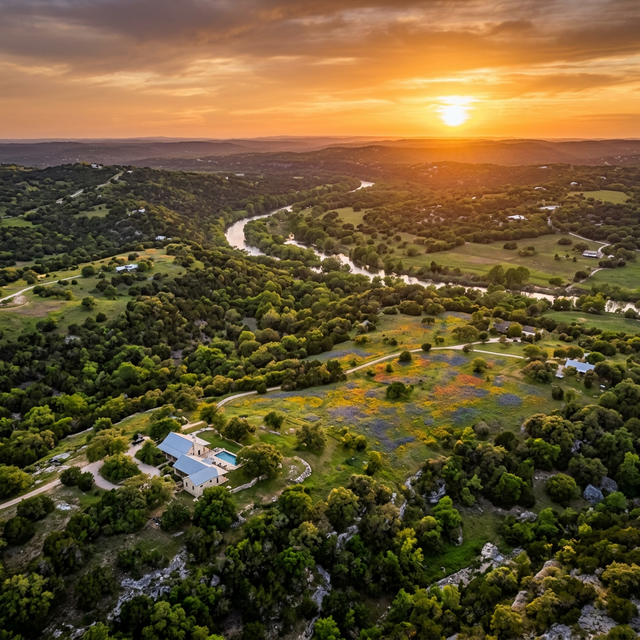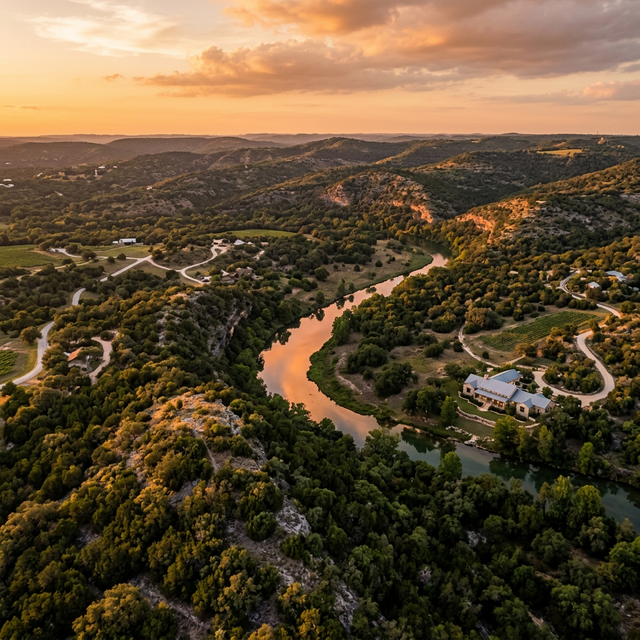
If you have been watching the Texas Hill Country land market over the past decade, you have witnessed something economists rarely agree on: a structural appreciation cycle rather than a speculative one. While residential markets in Austin and San Antonio have moved through the typical boom-and-correction rhythm, the Hill Country land market — particularly along the Boerne, Fredericksburg, and Kerrville corridors — has demonstrated a stubborn and data-backed upward trajectory that serious investors are only beginning to fully model.
The numbers are no longer subtle. According to the Texas Real Estate Research Center (TRERC) at Texas A&M University, land prices in the Austin-Waco-Hill Country region (Region 7) reached $7,911 per acre by the end of 2025, representing an 8.15% year-over-year increase. More telling is the five-year Compound Annual Growth Rate: 12.68%. That figure, sustained over five consecutive years, places Texas Hill Country land among the most consistently appreciating hard asset classes in the country.
The Three Structural Forces at Work
Three converging forces are reshaping land values in ways that have nothing to do with interest rate cycles or speculative sentiment. They are structural, demographic, and geological — and each one compounds the others.
Supply Finitude. The Texas Hill Country is geologically defined. The Edwards Plateau escarpment, caliche soils, and the cedar-juniper and live oak canopy that define the region are fixed. Development pressure from the I-35 corridor — particularly the San Antonio–Austin growth axis — has already absorbed significant productive tracts, and conservation easements are permanently removing additional acreage from future development. According to the Texas Land Trust Council, conservation easement acreage in Texas has grown by over 30% in the last five years, with Hill Country counties among the most active. Supply cannot increase to meet demand. It can only compress.
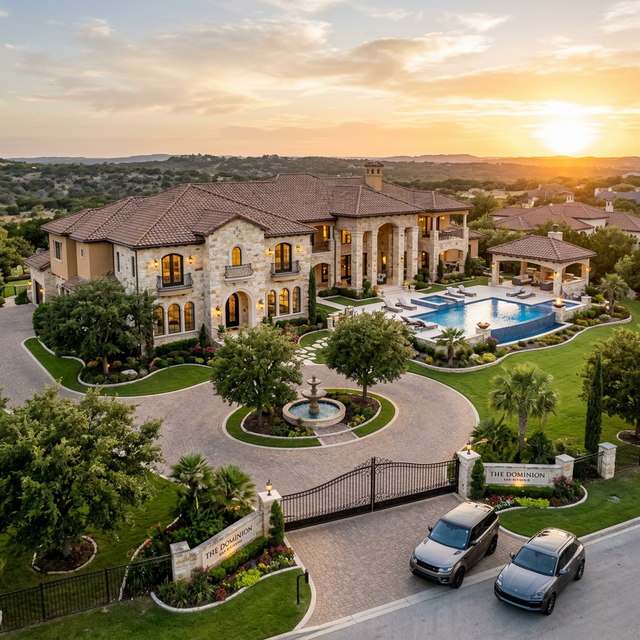
Migration Quality. The buyers arriving in the Hill Country have changed meaningfully. They are not retirees seeking modest weekend retreats. They are founders, executives, and family offices — buyers relocating from California, Illinois, New York, and increasingly from within Texas itself — who view acreage as both a lifestyle asset and a portfolio diversification tool. The buyer profiles entering the Hill Country increasingly involve high-net-worth individuals and family offices purchasing 50 to 500 acres as a primary or secondary residence, not a speculation play.
The Remote Work Structural Shift. Post-2020, the Hill Country graduated from a weekend-escape market to a legitimate primary-residence market. Starlink and fiber infrastructure in previously underserved rural counties, growing networks of luxury service providers (from private aviation FBOs to bespoke property management firms), and the normalization of location-independent executive work have fundamentally reduced the friction of living 60 to 90 minutes from a major metropolitan center. That friction, which once severely discounted rural acreage, has largely disappeared for a significant and financially powerful segment of the buyer population.
"Land in the Hill Country is no longer simply real estate. For family offices and high-net-worth individuals, it has become a store of value, an inflation hedge, a lifestyle platform, and a generational wealth vehicle — simultaneously."
The Data in Context
It is worth understanding what $7,911 per acre represents in context. In 2015, comparable Hill Country acreage was trading in the $3,000–$4,500 range in most productive corridors. The doubling — and in premium locations far more than doubling — of values over a decade reflects a market that has reset its floor, not one approaching a speculative ceiling.
Premium sub-categories have outpaced the regional average substantially. Guadalupe River frontage routinely commands $40,000 to $75,000 per acre for prime sections. Medina River tracts in the Bandera and Medina County corridors are consistently trading above $25,000 per acre. Spring-fed creek tracts — the rarest category — have seen off-market transactions above $100,000 per acre for exceptional parcels in the last 24 months.
Looking forward, TRERC's statewide forecast projects a nominal price per acre increase of approximately 2% through Q3 2026. Capitol Ranch Real Estate and other regional land specialists project 2–4% modest appreciation for 2026. These are conservative, data-grounded forecasts — not an argument for explosive gains, but a clear signal that the floor is rising and the available inventory is shrinking.
What This Means for Buyers in 2026
The clearest signal for buyers considering a Hill Country land acquisition in 2026 is deliberate urgency — not panic, but action structured around a framework. The tracts available in Boerne's prime sub-corridors (1604 north to the IH-10 west interchange) five years ago at $8,000–$12,000 per acre are now transacting at $18,000–$28,000 when they become available, which is less frequently than ever. The window for entry at these prices is narrowing.
For buyers seeking 50+ acre tracts with water features, hilltop positions, and paved road access — the highest demand configuration — the available pool at any given time in the Hill Country core is typically fewer than 20 listings. Off-market introductions, which account for the significant majority of our brokered land transactions, move faster because they reach a smaller, fully pre-qualified buyer pool. By the time a property appears publicly, the most motivated buyer has usually already been introduced.
At Kanye Concierge 360, we are building a network of Hill Country landowners and buyers who value discretion and strategic timing. If you are considering a land acquisition in 2026, we encourage you to begin that conversation now — before the spring season, which historically represents the most competitive acquisition environment of the year.
Get the free checklist — straight to your inbox
Drop your email and we'll send you the full guide, plus the occasional honest note on the San Antonio & Hill Country market. No spam, unsubscribe anytime.
Begin a Private Land Consultation
We work with a curated network of Hill Country landowners. Reach out to begin an introduction.
Request a Consultation